![[Instituto Presbiteriano Mackenzie]](/fileadmin/CONFIGURACOES/DEFAULT_21/Resources/Public/Template/img/logo/mackenzie_w.svg "Instituto Presbiteriano Mackenzie")
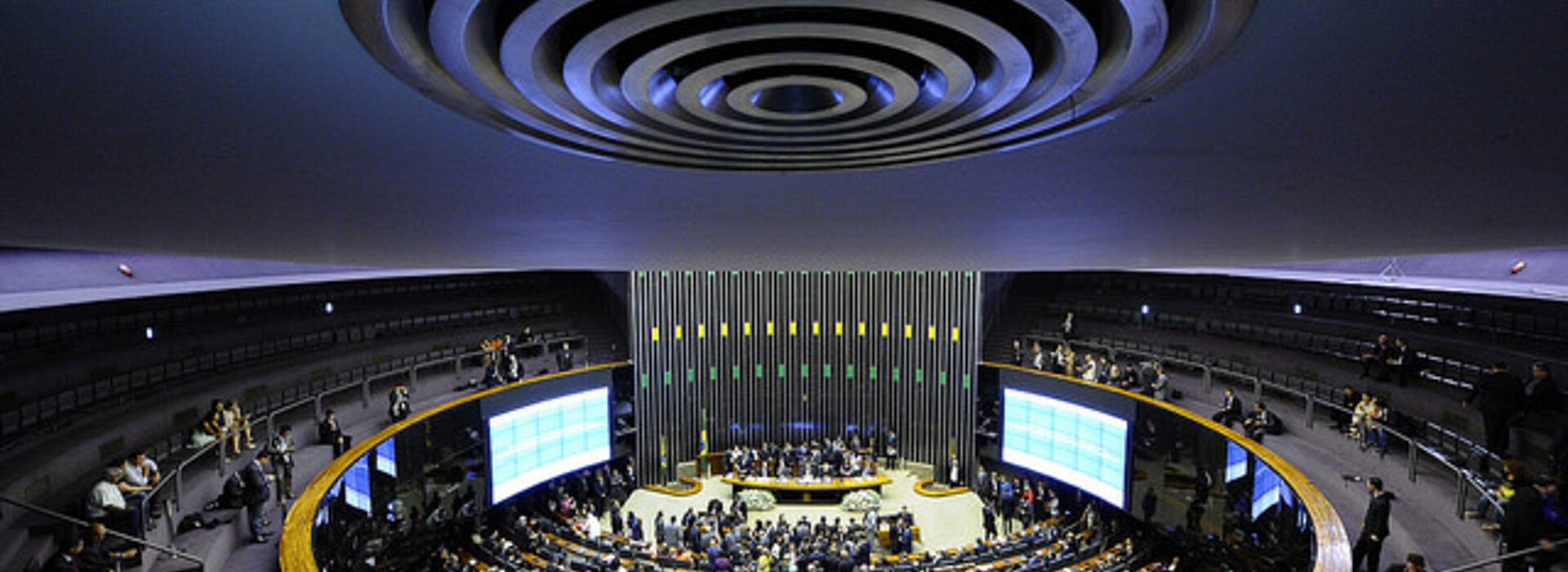
The entry into force of a national law is the end result of a long, and often time-consuming, political process unfolding in the Chamber of Deputies and the Federal Senate. For a good proposal or a good idea to become a law, the road is slow and not always clear. In addition to the planned steps that a bill must take to become an effective law, there are political disputes that, while not being openly and transparently addressed to voters and citizens, are decisive for approval or filing of a particular proposal.
In presenting the ways of the legislative process we show the legal and planned steps for what was once a proposal can become a law and make real the changes conceived. But the path is not simple and is not always agile. And, of course, there are reasons for that.
First, the National Congress consists of two houses, the Federal Chamber and the Senate. Each of them legitimates itself for different reasons: the first represents the Brazilian population, the people. Its representatives are elected in a proportional way respecting a minimum floor of 08 representatives and a ceiling of 70 representatives. The Federal Senate represents each of the 27 units of the Brazilian federation (26 states and 1 federal district). This difference of representative base is even explained because the Chamber is composed of 513 deputies and the Senate of 81 senators. For a project to become law, it must be approved by both houses. If the initiative of a project was in the House, after it is approved, it must be referred to the Senate. If the initiative is from the Senate, it will also need to be approved later in the House. And, if, for example, a bill approved by the House is approved with amendments in the Senate, these amendments return to the Chamber to be deliberation targets. However, before being approved in plenary, the projects go through specific commissions. The commissions are formed by groups of deputies and senators divided with themes like economy, environment, education among others.
Why is this path so long? Ensure that there are debates and discussions so that interested parties and potential affected, involved and interested in proposed bills are expressed and heard and considered by their representatives. It would be a democratic guarantee. After all, democracy is the system that must consider and respond to the demands of its citizens.
In addition, the stages of the legislative process are not simply technical procedures necessary for the democratic functioning of the institutions. They are political processes, they are the expression of politics, that is, the struggle for power. The discussions and debates in the committees and in the plenary oppose worldviews and oppose political projects, and each side devises strategies to try to win. When they can not win they devise strategies to postpone clashes to a situation that is more favorable to them. And in these disputes many projects end up not being taken to vote in plenary and do not gain the proper disclosure while others end up being approved without the due debate required.
In fact, such disputes and strategies are part of democracy, but are not adequately publicized or known to citizens. The legislative observatory also proposes to be a channel for explaining this dynamics and will soon publish a text that will focus mainly on power disputes in the legislature.
The following are the steps that form our legislative process.
LEGISLATIVE PROCEDURE
Legislative process
Concept
Instrument used for the manifestation of power for the purpose of drawing up a legislative act.
Legislative procedure
Concept
Means of formal manifestation of the process. It consists of the materialization of the acts practiced in the process.
Species
Ordinary or common - applicable, as a rule, to the drafting of ordinary law.
The bill, after approval in the Initiating House, should be sent to the Review House. In this, there are three hypotheses (article 65, CF):
I) approval without amendment - bill is forwarded to sanction or veto of the President of the Republic.
II) rejection - in this case, a new project is allowed to be filed, in the same legislative session (annual period in which the Congress convenes), upon submission of an absolute majority of any Houses (article 67, CF).
III) approval with amendments - return to the initiating House only for appreciation of the amendments. If they are also approved by the Initiating House, the bill will be forwarded to sanction or presidential veto. If the Initiating House rejects the Amendments of the Review House, the original design prevails, without the amendments proposed by the Review House.
Note: projects of initiative of the President of the Republic, of the Superior Courts and of popular initiative have as House initiating the Chamber of Deputies (articles 61, §2º and 64, CF).
Summary - applicable to the drafting of ordinary law on an emergency basis. Such a regime may be requested by the President of the Republic in bills of his initiative. In this case, each of the Houses must manifest itself in a successive period of forty-five days, under penalty of overrun of the tariff. If there is amendment, there are ten days for their appraisal. Special - applicable for constitutional amendments, complementary laws, delegated laws, provisional measures, etc. Phases of the ordinary legislative process Initiative (introductory stage) Amendments (constitutive stage) Voting and deliberation (constitutive stage) Sanction or veto (constitutive stage) Promulgation (complementary stage) Publication (complementary stage) Initiative Concept Consists of the legitimacy to present a bill. Species Contestant, common or general - awarded to more than one entity, in isolation or jointly. Ex .: complementary and ordinary laws (article 61, caput, CF) .Privative, reserved or exclusive - granted only to an entity. Ex .: President of the Republic (article 61, §1º, CF) .Popular - conferred on citizens as to ordinary and complementary laws (article 61, §2, CF). Requirements: a) presentation to the House of Representatives b) subscribed by at least one percent of the national electorate c) distribution of signatures by at least five states d) have at least three tenths percent of the voters in each of the five states Amendments Proposed by parliamentarians for the purpose of amending the bill. Additive Species - one that adds something to the design. Aglutinativas - that which merges with the other amendment. Modifying - the one that changes the project at specific point. Suppressive - that which removes part of the project.Substitutive - one that substantially alters the project, assuming the place. Voting or deliberationConsist in the collective act of the Houses of Congress for a decision by the Legislature on the bill. Discussion - technical studies in various committees of each Legislative House.It is necessary to discuss, vote and approve in both Houses of Congress, according to majority defined in the CF. Each House has two types of commission: a) technical or thematic - to appreciate the material aspects of the bill. It may present amendments or simply opinion, which is non-binding, not requiring a plenary deliberation and, neither, leading to rejection of the project. b) Constitution and Justice Commission - to assess formal aspects of the bill (constitutionality). The opinion is terminating, that is, if not, it means rejecting and shelving the bill. Note: After approval in the committees, the project is sent to the plenary of the respective House, for discussion and voting, as a rule. It is possible, however, that the committees discuss and approve a bill, without there being deliberation and voting in the plenary of any Houses of the Legislature in matters provided for in the Rules of Procedure, unless one tenth of the members of the House appeal, or Chamber of Deputies or the Federal Senate (article 58, §2, I, CF). Voting - there are four types: a) ostensive - nominal, in which the parliamentarian responds positively or negatively to the question presented to him. B) symbolic - in which the parliamentarians favorable to the project remain seated. c) Leadership - provided for in the Internal Rules of the Houses of Congress, although it is debatable. d) Secret constitutionality - in which there is no identification of voters. (B) complementary laws - absolute majority (article 69, CF) c) constitutional amendments - qualified majority of three fifths of the votes of the respective members , in two shifts, in each House of Congress (article 60, §2º, CF) Note: the mentioned quorum refers to the approval. For the installation of the deliberative session, the presence of an absolute majority is always necessary. In this sense, the terms have the following meaning: I) simple majority - a favorable vote of more than half of those present at the session. (Ii) absolute majority - a favorable vote of more than half the members of the House. Sanction Concept It is the agreement of the President of the Republic regarding the bill submitted for its consideration by the National Congress (article 84, IV, CF). SpeciesExpressa - a written statement by the President of the Republic within fifteen working days.Tácita - occurs when there is the silence of the President of the Republic within a period of fifteen business days, interpreting the absence of an expression of will as the consent of the Chief of the Federal Executive Branch (article 66, §3, CF) Veto ConceptConsist in the disagreement of the President of the Republic in relation to a bill that has been forwarded by the Legislature. Characteristics Funded - the motives for veto must be presented, which will be submitted to the National Congress for consideration.Obs .: the communication of such motives must occur to the President of the Fed Senate.
(Article 66, §1, CF) .Relative, limited or conditional - the veto of the President of the Republic can be rejected by the Legislative Power.Obs .: the assessment in joint session of the National Congress must occur in up to thirty days. For the rejection, there must be a vote of the absolute majority of the Deputies and Senators, in secret ballot (articles 66, §4, and 57, §3, IV). Suspensive or superlative - the veto represents an obstacle, initially temporary, to the entry into force of the norm approved by the Legislature. Irrecoverable - there is no possibility of the President of the Republic giving up the veto. As for the legal motivation - for considering the bill contrary to the Constitution. Political - considering the bill contrary to the public interest. As for the Total amplitude - the veto reaches the integrality of the bill. Partial - the veto reaches part of the bill. 1: The veto must be read in full text of article, paragraph, paragraph or point (article 66, §2º, CF), not only on words (to avoid any change of meaning and consequent violation of the legislative will manifestation). Promulgation An official act that has the function of attesting the existence of a law. Normally, the promulgation is made by the President of the Republic, within forty-eight hours after tacit sanction or rejection of a veto, such act shall be practiced by the President and Vice President of the Federal Senate, successively (articles 66, §7 and 84, IV, CF). PublicationCommunication made to the population in the Official Gazette regarding the existence of a new law. Unless otherwise provided, the law shall be in effect throughout the national territory within forty-five days after publication (art. Rules of Brazilian Law). This period between the publication of a law and its entry into force is called vacatio legis. FONTES CONSULTADASCHIMENTI, Ricardo Cunha et alii. Course of constitutional law. 7. ed. rev. and current. São Paulo: Saraiva, 2010. CINTRA, Antônio Carlos de Araújo et alii. General theory of the process. 18. ed. São Paulo: Malheiros, 2002. PAULO, Vicente; Page 2 Uncomplicated constitutional law. 14. ed. Rio de Janeiro: Forensic; São Paulo: Method, 2015.PINHO, Rodrigo César Rebelo. Of the organization of the State, of the Powers and history of the Constitutions. 11. ed. São Paulo: Saraiva, 2011.SILVA NETO, Manoel Jorge e. Course of constitutional law. 8. ed. São Paulo: Saraiva, 2013.SILVA, José Afonso da. Course of positive constitutional law. 37. ed. rev. and current. São Paulo: Malheiros, 2014.