
As a non-profit and charitable association, operating with social responsibility is inherent at Mackenzie, whose very roots evoke innovation in education with principles of diversity and inclusion. These bases are solidified in the philanthropic nature of the Institution and are translated, in part, in the granting of scholarships and consequent offer of opportunities to those who could not, by their own means, enjoy the benefits of study at Mackenzie. They are also manifested through socio-environmental projects whose purpose is to benefit communities that are related to the Institution.
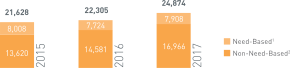
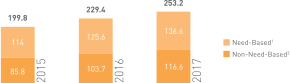
Mackenzie develops its own social projects, some of these are appropriated for philanthropic governmental incentives and some are self-motivated and funded. In the social projects appropriated for tax benefits, according to current Brazilian legislation, the values of projects and activities are destined to the expansion of educational services and the support of scholarship students. Projects not eligible for fiscal incentives are maintained by the Institution because they meet its statutory and confessional purposes. Some of them are conducted exclusively with Mackenzie’s own funding and others in partnerships.
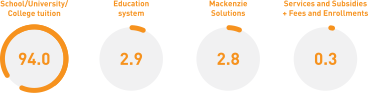
In 2017, the investments in socio-educational projects, with almost 197 thousand direct beneficiaries, reached R$2.6 million, of which R$1.0 million is free tuition contemplated by Brazilian legislation (Law no. 12.101/09).

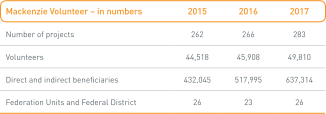
The project aims at encouraging volunteering, community participation and social entrepreneurship by promoting voluntary educational actions involving students and the community in general in projects that focus on the 17 Sustainable Development Goals established by the United Nations Organization (UNO). Another relevant aspect is its result in terms of participation of volunteers and supporters through service and donation of materials.
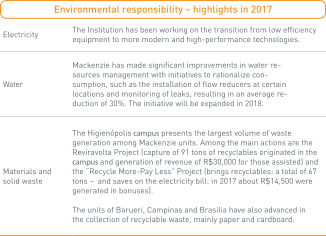
Environmental sustainability permeates several action fronts at Mackenzie, from educational contents and field lessons in Basic Education, through research and extension projects carried out by UPM, to projects on efficient water and energy management – fundamental resources for the maintenance of activities in campi.
In this context, Mackenzie Environmentally Responsible Program (MAR) has the role of promoting dialogue between academia and the Institute to find solutions that support the environmental management of the organization as a whole.
Mackenzie maintains firm and strategic economic and financial management, backed by annual budget planning aimed at the sustainability of operations.
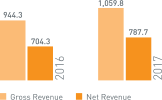

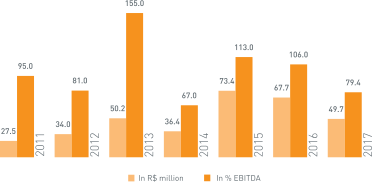
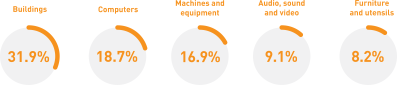
The policy of Mackenzie is to reinvest all of the gains accrued as a result of its activities. The following historical series shows that investments reached an average of 99.5% of EBITDA between 2011 and 2017.
 Nº
Nº
